
Hip Pain Physiotherapy
Assessment and rehabilitation for hip stiffness, bursitis, and groin-related pain in Mayville, Pretoria — restoring pain-free walking and movement.
- No referral needed
- Medical aid billed directly
- Full-hour assessment
Introduction
Hip and pelvic pain can be surprisingly disruptive, affecting how you sit, walk, exercise, sleep, and even how comfortable you feel standing for longer periods. The hip joint and pelvis play a central role in transferring load between your upper and lower body, so when something feels "off" in this area, everyday movement can quickly become frustrating.
Research suggests that around 10–15% of adults experience hip pain at some point, with prevalence increasing with age and activity demands. Hip and pelvic presentations go by several names, including hip osteoarthritis, femoroacetabular impingement (FAI), groin strain, greater trochanteric pain syndrome, and sacroiliac joint pain, and the right approach depends on which pattern fits your presentation.
For many people, symptoms develop gradually rather than from one specific injury, which can make the pain confusing or concerning. The good news is that hip and pelvic pain responds very well to physiotherapy, with the right assessment and a clear, structured plan to restore comfortable movement. A full-hour first assessment at our Mayville practice gives time to properly distinguish between hip-joint, muscular, and sacroiliac sources of pain, an important distinction since treatment differs.
Anatomy & Biomechanics
The pelvis and hips form a strong, stable base for movement, designed to handle large forces while still allowing freedom to walk, run, bend, and rotate. The hip itself is a deep ball-and-socket joint, built for both mobility and load-bearing, while the pelvis acts as a central link between the spine above and the legs below.
These joints are supported by powerful muscles, including the gluteals, hip flexors, adductors, and deep stabilising muscles, that help control movement and absorb load. Pain often develops when these tissues are exposed to more stress than they're currently prepared for. Importantly, pain does not automatically mean damage; it usually reflects a temporary mismatch between load, movement, and recovery, and imaging findings like mild osteoarthritis or FAI often appear in pain-free hips too.
- The hip joint – femur (thigh bone) and acetabulum (socket), a deep ball-and-socket joint built for both mobility and load-bearing
- The pelvic bones – ilium, ischium, and pubis, forming the bony ring that anchors the spine to the legs
- The sacroiliac joints – connecting the pelvis to the spine, absorbing and transferring load between the upper and lower body
- Gluteal and deep hip rotator muscles – controlling hip movement and stabilising the pelvis during walking and standing
- Hip flexors and adductors – muscles crossing the front and inside of the hip, frequently involved in groin-related strains
- Nerves – including the sciatic and femoral nerves, which travel through and around the hip and pelvis
What Causes Pelvic & Hip Pain (Acute vs Chronic)
Hip and pelvic pain can begin suddenly or build up gradually, and both patterns are common.
Acute pain tends to come on suddenly and is often linked to a clear event, such as a fall, a sudden twist, sprinting, or lifting something heavy. This pain may feel sharp or catching initially, and often settles well with appropriate early management, particularly when movement is encouraged rather than avoided altogether.
Chronic or gradual-onset pain is far more common. In many cases, there isn't one single cause. Instead, pain builds up slowly as smaller stresses accumulate over time, especially when recovery or movement variety is limited. This is particularly true where hip and pelvic strength has gradually declined, whether from reduced activity, a change in training, or compensating for pain elsewhere in the body.
- Prolonged sitting at a desk or in the car
- Sudden increases in walking, running, or gym training
- Reduced hip strength following an old injury
- Compensating for pain elsewhere, such as the lower back or knee
- Sports involving repetitive kicking, sprinting, or change of direction, such as rugby or football
Common Symptoms
Symptoms vary. Fluctuation is normal and usually reflects how the area is responding to load and recovery. Common experiences include:
- A dull ache or stiffness in the hip, groin, buttock, or pelvic region
- Discomfort after sitting for long periods
- Pain or catching with certain movements: getting out of a car, putting on shoes, climbing stairs
- Reduced range of motion, particularly rotating or bringing the leg across the body
- A feeling of instability or weakness through the hip and pelvis
How This Affects Your Day-to-Day
Hip and pelvic pain rarely stays contained to just the hip. It can quietly limit some of the most ordinary daily movements.
- Struggling to get comfortable sitting through a long meeting or a car ride
- Wincing when getting out of a low chair or the car
- Avoiding a run, gym session, or game of rugby, worried about how the hip will hold up
- Feeling stiff or unsteady putting on shoes and socks
For many people, it's not just the pain itself, but the constant small workarounds around it that wear them down.
Why It Might Not Be Improving
A few patterns commonly keep hip and pelvic pain lingering longer than it needs to:
- Resting completely rather than staying gently active. This often stiffens the hip further rather than settling it.
- Avoiding movement out of fear of causing more damage. Understandable, but this tends to reduce strength and control over time rather than protect the hip.
- Managing only the symptom, such as heat, occasional stretching, or pain medication, without addressing the strength and control that's actually driving the load through the hip.
- Not having a clear diagnosis yet. Without knowing your specific pattern, joint-related, muscular, or sacroiliac, it's hard to know what actually needs to change.
- Returning to running, training, or sport too quickly, before strength and control have properly recovered.
The Solution: Getting the Right Diagnosis
Understanding exactly which pattern is driving your hip or pelvic pain, rather than guessing, is the most reliable way to move forward with confidence.
Common Diagnoses
Several clinical labels help guide treatment, though imaging findings don't always match symptoms:
Hip osteoarthritis
describes age-related joint changes that don't always correlate with pain severity, many people with significant changes on imaging have little to no pain, and vice versa. Physiotherapy focused on strength and movement is one of the most effective interventions available.
Femoroacetabular impingement (FAI)
is a variation in hip joint shape that can become symptomatic with certain loads, particularly deep hip flexion or rotation (common in athletes and dancers). Management is usually strength- and movement-based, with surgery reserved for cases that don't respond to conservative treatment.
Labral irritation or tears
involve sensitivity of the cartilage rim around the hip joint. As with other joint cartilage findings, labral changes are common in imaging even without symptoms. Treatment focuses on strength and load management rather than the imaging finding alone.
Greater trochanteric pain syndrome
causes pain on the outside of the hip related to tendon overload, common in runners and in people who've recently increased walking or standing time. Responds well to targeted loading and activity modification.
Hip flexor or adductor strains
are muscle-related pain, often linked to activity changes, common in football, rugby, and sports involving sprinting or kicking.
Sacroiliac joint pain
arises from the joints between the pelvis and spine, and can present as one-sided lower back or buttock pain, sometimes confused with lumbar back pain, which is why proper assessment matters.
How Physiotherapy Can Help
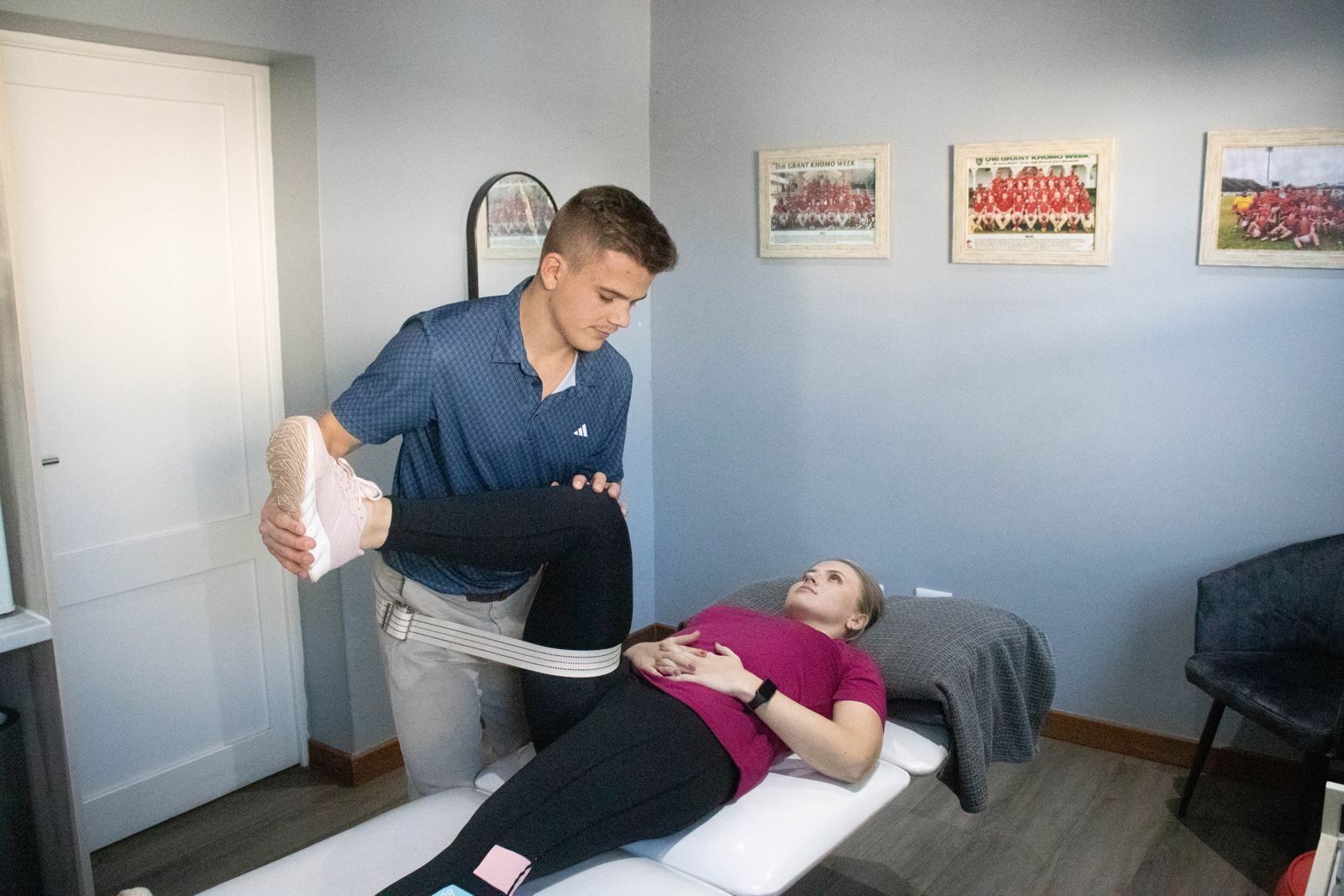
Physiotherapy for hip and pelvic pain starts with a thorough assessment, distinguishing hip-joint, muscular, and sacroiliac sources of pain, and understanding your daily and activity-specific demands. Treatment typically includes:
- Therapeutic exercise: the foundation of most hip rehabilitation, rebuilding strength through the gluteals, hip flexors, and deep stabilisers
- Joint mobilisations to restore hip movement where stiffness is contributing to symptoms
- Dry needling for muscle tightness in the hip flexors, glutes, or deep rotators contributing to pain
- Neural mobilisations where nerve irritation, such as sciatic or femoral nerve involvement, is contributing to buttock, groin, or leg symptoms
- Movement analysis for runners and athletes, to identify loading patterns contributing to overuse-type hip pain
- Strapping and taping for short-term support during return to running, training, or sport
- Education and load management, particularly relevant for desk-based work, prolonged sitting, and gradual return to running or sport
Recovery timelines vary by diagnosis, and these are always approximations. Muscle-related hip and groin pain often improves within 4–8 weeks; joint-related presentations like FAI or osteoarthritis typically take longer, often in the region of 6–12 weeks, as part of a longer, strength-focused programme. We regularly treat patients from The Moot, Mayville, and across Pretoria for hip and pelvic presentations.
Related Conditions We Treat
Not sure this is the right fit? These related conditions might explain what you're experiencing more precisely: Back & Sciatica Pain, Knee Pain, Thigh Pain.
Frequently Asked Questions
What causes hip and pelvic pain?
A wide range of causes, including joint changes (osteoarthritis, FAI), muscle or tendon overload, or sacroiliac joint irritation. Your assessment identifies which pattern fits your presentation.
Do I need an X-ray or MRI for hip pain?
Not usually as a first step. Clinical assessment is often more useful for guiding treatment, and imaging findings like mild arthritis or labral changes are common even in pain-free hips.
How long does hip pain take to improve?
It depends on the cause, and recovery estimates are always approximate. Muscle-related hip and groin pain often improves within 4–8 weeks, while joint-related presentations typically take longer, often 6–12 weeks, as part of a strength-focused programme.
Can physiotherapy help hip arthritis?
Yes. Exercise and strengthening are among the most effective interventions for hip osteoarthritis, helping manage pain and maintain function, often reducing reliance on other treatment.
Should I stop exercising if I have hip pain?
Usually no. Complete rest tends to slow recovery. Your assessment identifies which movements to modify and which strengthening work will help.
Is my hip pain actually coming from my back?
Sometimes. Lower back and sacroiliac joint issues can present as hip or buttock pain, and vice versa. Proper assessment distinguishes between the two, which matters for treatment.
Can groin strains be treated without surgery?
Yes, in the large majority of cases. Structured, progressive strengthening is the standard approach for hip flexor and adductor strains, with surgery rarely needed.
What is FAI (femoroacetabular impingement) and does it need surgery?
FAI is a variation in hip joint shape that can become symptomatic with certain movements. Most cases respond well to strength and movement-based physiotherapy; surgery is generally considered only when conservative treatment hasn't helped.
Do you treat runners with hip pain?
Yes. Hip-related running injuries (greater trochanteric pain, hip flexor overload) are common, and movement analysis is often useful for identifying contributing loading patterns.
Does medical aid cover hip and pelvic physiotherapy?
Yes, we bill most South African medical aids directly. Get in touch and we'll confirm your specific plan's benefit.
Do I need a referral to see you for hip or pelvic pain?
No. You can book directly with us. If your medical aid requires a referral for reimbursement, we'll help guide you through that.
Peak Physiotherapy · Mayville, Pretoria
Ready to get moving again?
Book an assessment and get a clear plan for hip pain — no referral needed.